Hoppin
The new mobility vision Hoppin means that you will be able to reach your destination in Flanders more easily. How? By De Lijn Flex: your journey from A to B will take place using several efficiently coordinated, sustainable means of transport.
Together with Hoppin in Flanders, we are making the transition to more efficient, sustainable and flexible public transport.
To travel between one city and another, for example, you can make use of the improved rail service. Frequent trams and buses mean you can get into the city quickly by the major traffic routes. And for the shorter parts of your journey you can use accessible and flexible transport. Whether you travel alone, in a group, frequently or regularly, journeys are going to get easier for everyone!
Hoppin: towards tomorrow’s mobility together
Trains, trams and buses remain the baseline. Where there is high demand for public transport, more will be provided, designed to take account of our cycling and road network:
trains on busy routes between cities
buses and trams in city centres and providing more direct links to key destinations such as schools and hospitals.
In this way, we are matching our supply more closely to the demand from our passengers
This is the key principle of the new mobility vision of the Flemish government’s together with cities & municipalities. Public transport is central to this vision, but you will also combine different means of transport more often that are coordinated with each other. You will be able to transfer more easily to flexible transport such as sharing systems (cars, bicycles, scooters) – see the fourth layer of the layered transport model below.
Such transfers will be made at a Hoppin Point – a node where various means of transport meet. We call this combined mobility.
The new model is currently being worked on actively, and we are of course playing our part here at De Lijn. How are we doing so and what does this mean for you?
The basis: a layered transport model
Hoppin is made up of four layers.
The rail network: the backbone of public transport.
The core network: part one of the new network. This is the backbone of urban and regional transport. Buses and trams connect centres, serve centrally located key destinations and link suburbs with other cities.
The supplementary network: part two of the new network. Buses between smaller cities and municipalities feed the core network and the rail network. Commuter journeys and transport between home and school that only exist during the rush hour can also form part of this network.
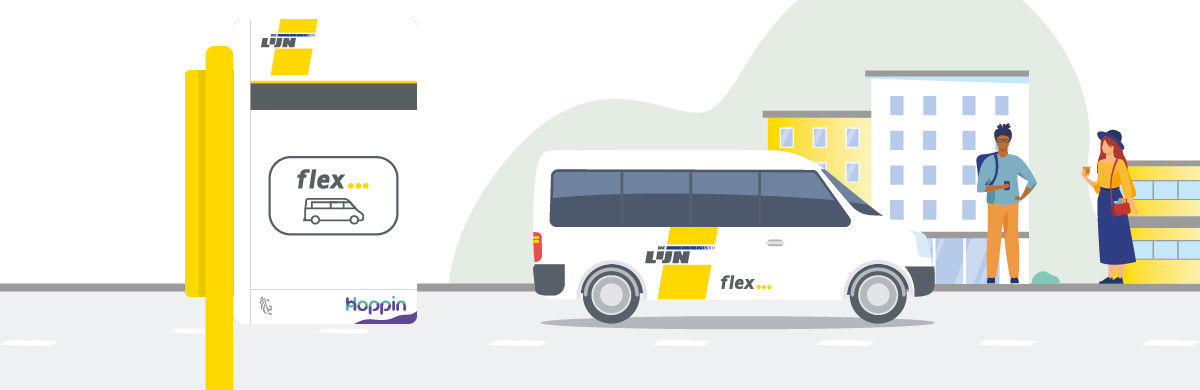
Flexible transport: ‘flexible’ transport provision. This could be a flexbus or -taxi, which can be booked on demand, a shared car or bicycle, or another sharing system. It also includes Hoppinflex+: the service for people with reduced mobility (target group transport).
By coordinating these four layers optimally with one another, we can achieve an efficient transport model.
Combined mobility means combining different modes of transport to suit your requirements, chosen from the layered transport model above.
Example: you ride your bike to the nearest De Lijn stop, where you take the De Lijn bus to the Hoppin Point. From there you ride the Hoppin bike (or scooter) to your final destination.

1st Mile Hoppin
There are numerous combination options, including for people with a mobility or other impairment.
How will you benefit as a traveller?
How do you currently travel to school, work or other destinations? It’s very likely that you already combine different means of transport: train, bus or tram, your own bike or car, a shared bike or scooter, ... If all these means of transport are coordinated even better, you will reach your destination more easily.
Precisely because we are placing maximum emphasis on the accessibility of major transport axes and through the seamless interlinking of the four layers of the network, you will therefore:
travel more easily by public transport
complete your journeys quickly.
Hoppin is an initiative by the Flemish government together with cities & municipalities aimed at ensuring that everyone can travel around quickly and conveniently.
Line number reform
De Lijn is also taking this opportunity to reform its system of line numbers. From now on, you will know which type of line it is by the number of digits or the letter of your line number. High-frequency city lines will have a one-digit number. A regional line (cadence line) that you can count on for a whole day will have two numbers. Lines with three numbers are functional lines that only run during rush hour, for example, in function of schools or commuting.
Tram lines have the prefix T or M if they also run underground, express lines X (from express line) and night lines N.